
Last Updated: September 4, 2026
Canadian Wilderness Wonders – the great and varied sceneries of Canada can serve outdoor lovers with a play ground of amazing beauty and nothing could be better to show the colors of wilderness which is signified by camping and fishing.
Whether you are on top of the Rocky Mountains or the calm waters of Ontario, this guide shall take you on an adventure tour of some of the best places to go camping and fishing in Canada with a list of things you must have in order to make the experience memorable.
Table of Contents
Camping and Fishing Locations in Canada:
-
Banff National Park, Alberta:
The Banff national park is the jewel of the lovers of camping and fishing because it is situated in the heart of the Canadian rocky mountains. Choose one of the clean lakes and rivers nearby a town e.g. Lake Louise or Bow River to ensure an idyllic setting in the snow-capped mountains and rich wildlife.
-
Algonquin Provincial Park, Ontario:
It is said to have plenty of forests in the Algonquin provincial park in Ontario and this is what makes the park the most appropriate place where an individual can extract camping and fishing in Canada. It also possesses more than 2400 lakes in order to find the appropriate site to camp and fish not only different species of fish but also walleye, northern pike and lake trout.
-
Gros Morne National Park, Newfoundland and Labrador:
Explore the scenic landscapes of the Gros Morne National Park which is endowed with fjords, mountains and coastal cliffs as beautiful landscape. Take a camping on the sea, and fish in both salt and fresh water, of all sorts of fish in the world, such as Atlantic salmon and Arctic char.
-
Jasper National Park, Alberta:
Jasper national park is another fantastic jewel to Canadian Rockies and a pristine wilderness camping and fishing adventure. Fish brook trout and whitefish on the banks of the Maligne Lake and enjoy the beauty of mountain scenery when you spend your time.
Camping Fees & Features
| Location | Park Entry Fee | Camping Cost (Per Night) | Backcountry Fees | Camping Features |
| Jasper National Park, Alberta | Adult $12.25/day or Discovery Pass | $19.75–$86.50; cabins higher | $15 per person/night | Remote wilderness, dark-sky preserve, glacier-fed lakes |
| Algonquin Provincial Park, Ontario | Vehicle permit required (~$18–$25/day) | $38–$60+ (developed sites) | ~$12.43 per person/night | Forest camps, canoe-access sites, wildlife-rich zones |
| Gros Morne National Park, Newfoundland & Labrador | Adult ~$11/day | $30–$40 unserviced; cabins ~$130+ | Varies by zone | Coastal camping, fjords, ocean access, basic services |
| Banff National Park, Alberta | Adult $12.25/day or Discovery Pass | $19.75–$86.50 (campground); oTENTik ~$147 | $15 per person/night | Mountain views, lakeside camps, washrooms, fire pits, RV access |
Fishing Fees & Features
| Location | Fishing Permit Cost | Issuing Authority | Fish Species | Fishing Features |
| Banff National Park, Alberta | $15/day or $51.25/year | Parks Canada | Cutthroat trout, brook trout, whitefish | Alpine lakes, glacial rivers |
| Jasper National Park, Alberta | $15/day or $51.25/year | Parks Canada | Brook trout, lake trout, whitefish | Clear waters, low angling pressure |
| Gros Morne National Park, Newfoundland & Labrador | Park permit + provincial salmon licence | Parks Canada & NL Govt. | Atlantic salmon, Arctic char | Coastal rivers, freshwater & saltwater |
| Algonquin Provincial Park, Ontario | Provincial licence required (varies by term) | Ontario Ministry of Natural Resources | Walleye, pike, lake trout, bass | 2,400+ lakes, canoe fishing |
Must-Have Camping and Fishing Equipment: Canadian Wilderness Wonders
- Quality Tent
- Sleeping Bag and Pad
- Cooking Gear
- Fishing Gear
- Weather-Appropriate Clothing
- Navigation Tools
- First Aid Kit
- Fishing Chair
Mountain Wilderness (Canada)
| Aspect | Description | Ecological Importance |
| Major Mountain Regions | Canadian Rockies, Coast Mountains, Columbia Mountains, Torngat Mountains | Anchor large, intact wilderness corridors |
| Key National Parks | Banff, Jasper, Yoho, Kootenay, Mount Revelstoke, Torngat Mountains | Preserve alpine biodiversity |
| Climate Characteristics | Cold winters, cool summers, high precipitation | Creates distinct ecological zones |
| Glaciers and Icefields | Columbia Icefield, Wapta Icefield | Critical freshwater sources |
| Freshwater Role | Headwaters of major rivers | Supports agriculture and cities downstream |
| Dominant Vegetation Zones | Montane, subalpine, alpine tundra | High plant specialization |
| Flagship Wildlife | Grizzly bears, mountain goats, bighorn sheep | Indicator of ecosystem health |
| Biodiversity Level | High elevation-specific endemism | Highly vulnerable to warming |
| Human Pressure | Tourism, infrastructure development | Requires active conservation management |
| Climate Change Impacts | Glacier retreat, altered snowfall | Long-term water security risk |
| Global Significance | Climate regulation and water storage | Critical for continental ecosystems |
Freshwater Wilderness (Canada)
| Aspect | Description | Ecological Importance |
| Global Freshwater Share | Canada holds ~10% of the world’s freshwater | Critical for planetary water security |
| Lakes and Rivers | Over 2 million lakes and major river systems | Sustains ecosystems and human use |
| Key Freshwater Regions | Great Lakes Basin, Mackenzie Basin, Athabasca Basin, Algonquin Park | Long-term ecological stability |
| Wetlands Coverage | ~25% of global wetlands | Climate regulation and flood control |
| Water Quality Role | Natural filtration through soils and plants | Protects drinking water sources |
| Flagship Species | Beavers, lake trout, loons | Maintains trophic balance |
| Migratory Bird Habitat | Major stopovers for flyways | Global biodiversity connectivity |
| Indigenous Dependence | Central to food and cultural systems | Sustains long-term conservation |
| Threats | Pollution, climate warming, invasive species | Affects fish survival rates |
| Climate Change Impact | Altered ice cover and flow timing | Affects fisheries and wetlands |
| Global Significance | Climate buffering and biodiversity support | High conservation priority |
Cost for Exploring Canadian Wilderness Wonders
| Category | Subcategory/Details | Cost Range (per person) |
| Transportation | International flights (from India/Europe/Asia) | $800–2,000+ USD |
| Domestic flights (e.g., Vancouver ↔ Calgary ↔ Whitehorse ↔ Iqaluit) | $150–600+ USD per segment | |
| Car rental (fuel extra) | $50–150+ USD per day | |
| Train/buses (e.g., VIA Rail) | Variable by season/distance | |
| National Parks Access & Permits | Parks Canada Discovery Pass (1 year, unlimited entry) | ~CAD $69 adult; ~CAD $139 family |
| Single park gates | ~CAD $7–10 per day | |
| Backcountry permits/reservations | Varies by park/activity | |
| Accommodation | Camping (self-catered, frontcountry) | ~$15–40+ CAD per night |
| Hostels/budget hotels | ~$50–120+ CAD per night | |
| Mid-range hotels/lodges | ~$150–350+ CAD per night | |
| Remote lodges/cruises/expedition bases | $500–2,000+ CAD per night | |
| Tours & Guided Expeditions | 7–10 day guided Rockies tour (basic inclusions) | ~$2,200–2,500+ USD |
| Luxury Rockies tours | ~$5,800–6,700+ USD | |
| Wilderness canoe expeditions (e.g., Iconic Canada) | ~$2,350+ USD | |
| Multi-day guided wilderness/adventure tours (average) | $210–$570+ USD per day | |
| Food & Daily Expenses | Self-catering/groceries | ~$20–40+ CAD per day |
| Restaurant meals | ~$40–100+ CAD per day | |
| Miscellaneous (gear, permits, park fees) | Variable |
Keeping Nature Clean During Camping – Canadian Wilderness Wonders
Camping is an honor that allows one to take care of the clean beauty of nature in the great outdoors. As the lovers go out to enjoy the nature in the various parts of Canada, there is the need to appreciate and learn the importance of ensuring that the environment is clean. That is why the principle of environmental integrity should be in the center of mind of every camper:
- Preserving Ecosystems
- Protecting Wildlife
- Safeguarding Water Sources
- Leave No Trace Principles
- Community and Cultural Respect
- Educating Fellow Campers
- Future Generations
- Personal Connection with Nature
Arctic and Subarctic Wilderness (Canada)
| Aspect | Arctic Wilderness | Subarctic Wilderness | Research-Based Significance |
| Geographic Location | Northernmost Canada (Nunavut, Arctic Archipelago) | Northern Yukon, NWT, Northern Quebec, Labrador | Covers Canada’s highest-latitude ecosystems |
| Climate Characteristics | Extreme cold, polar nights, short summers | Long cold winters, slightly warmer summers | Arctic warming occurs 3–4× faster than global average |
| Dominant Ecosystems | Tundra, ice caps, polar deserts | Boreal forest–tundra transition zone | Critical for permafrost and carbon storage |
| Key National Parks | Quttinirpaaq, Auyuittuq | Tuktut Nogait, Wapusk | Protects vast, intact wilderness landscapes |
| Flagship Wildlife Species | Polar bears, Arctic fox, seals | Caribou, wolves, muskoxen | Species are climate-sensitive indicators |
| Vegetation Type | Mosses, lichens, dwarf shrubs | Sparse conifers, shrubs, tundra plants | Low-growing plants stabilize soil and ice |
| Permafrost Presence | Continuous permafrost | Discontinuous permafrost | Thawing permafrost releases stored carbon |
| Freshwater Systems | Glacial meltwater streams | Lakes, rivers, wetlands | Supports migratory birds and fish |
| Human Presence | Very limited, mainly Inuit communities | Small Indigenous and northern settlements | Traditional ecological knowledge informs conservation |
| Climate Change Impact | Sea ice loss, habitat fragmentation | Increased wildfires, shifting tree lines | Alters wildlife migration and food systems |
| Global Importance | Regulates planetary climate systems | Buffers boreal–Arctic transitions | Essential for global climate stability |
Canadian Wilderness Rune Discovery
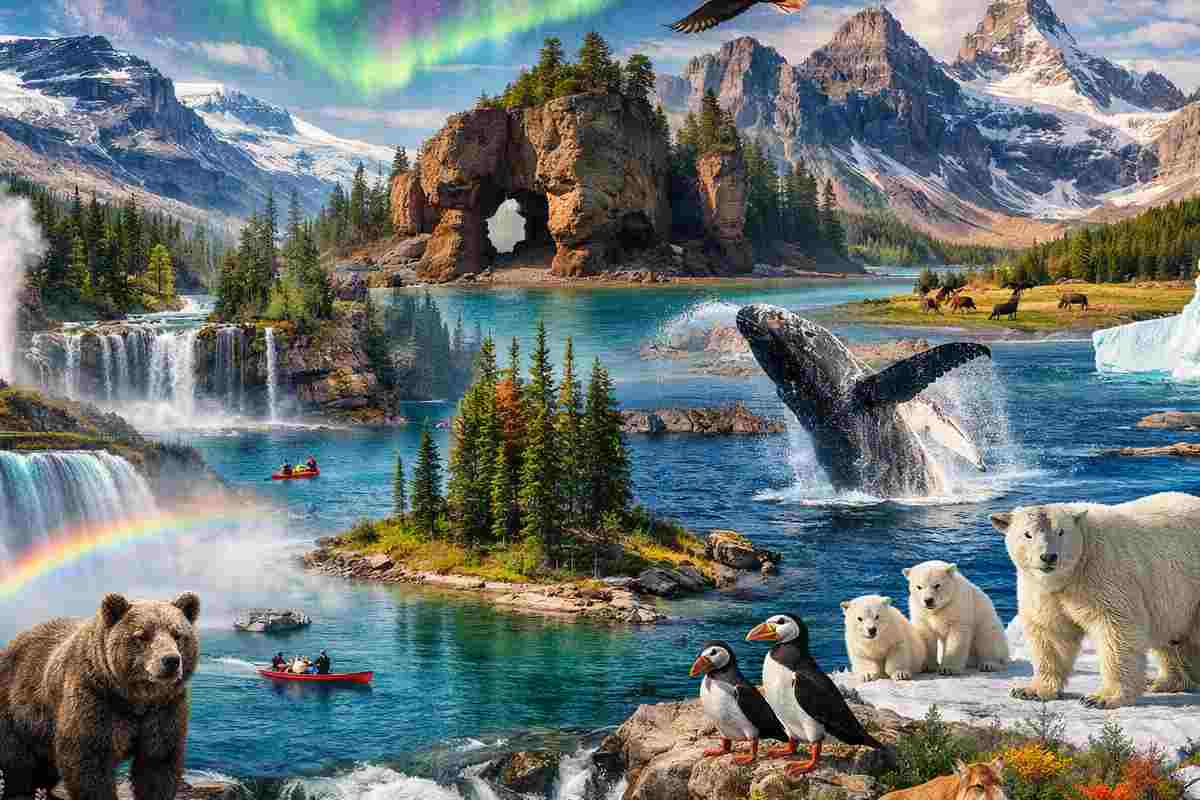
The theory of the find of the runes in the wilderness in Canada has been the focus of attention of historians, archeologists, and admirers of Norse exploration since long ago. These assertions usually are based on stone carvings or inscriptions that appear to be Norse runes, and indicate the likelihood of pre-Columbian contact between Scandinavians and North America other than the well-known Viking site at L’Anse aux Meadows.
Historical Context
- It is known that the Norse arrived in Canada as early as 1000 CE, with L’Anse aux Meadows, Newfoundland and Labrador being the place of their settlement.
- Beyond this site, alleged rune stones have been reported in Ontario, Manitoba, and the Arctic regions, often found in remote forested or wilderness settings.
- It has been agreed among academia that no proven rune inscriptions have been provenanced out of L’Anse aux Meadows.
Notable Rune Claims
- Heavener-type inscriptions (Ontario/Manitoba): Often cited in fringe literature but generally attributed to natural weathering or later historic markings.
- Arctic stone markings: Sometimes interpreted as Norse symbols but more plausibly linked to Indigenous petroglyph traditions.
- Stones of forest and lakeside: Often are found by trail-blazers or campers; most of them have no archaeological setting, and little to be carbon-datable.
Archaeological Evaluation
Professional archaeologists assess rune claims using:
- Contextual excavation (stratigraphy and surrounding artifacts)
- Tool-mark analysis
- Linguistic accuracy of runic characters
- Cultural alignment with known Norse material culture
To date, none of the wilderness rune discoveries meet these validation standards.
Indigenous Perspectives
Many markings initially labeled as “runes” are now understood as:
- Indigenous petroglyphs
- Territorial or spiritual symbols
- Geological features of nature
In contemporary studies, it is important to respect the Indigenous interpretations as opposed to the imposition of other historical accounts.
Why the Myth Persists
- The wilderness in Canada is vast and sparsely populated which creates speculation.
- Unproven finds are enhanced by popular culture and pseudo-historical theories.
- Genuine Norse history in Newfoundland lends plausibility to broader claims.
Current Scholarly Consensus
- There is only L’Anse aux Meadows, which is verified Norse activity in Canada.
- The discoveries of the wilderness rune are still unverified and scholarly.
- Present studies are based on the documented archeological findings, and not isolated surface finds.
Coastal Wilderness and Marine Ecosystems (Canada)
| Aspect | Description | Ecological Importance |
| Ocean Boundaries | Pacific, Atlantic, and Arctic Oceans | Links terrestrial and marine ecosystems |
| Major Coastal Regions | Great Bear Rainforest, Bay of Fundy, Gulf of St. Lawrence, Arctic Archipelago | High biodiversity value |
| Marine Ecosystems | Kelp forests, eelgrass meadows, cold-water coral reefs | Supports marine food webs |
| Tidal Dynamics | Bay of Fundy’s extreme tides | Drives nutrient mixing |
| Flagship Marine Species | Whales, seals, sea otters, seabirds | Indicator of marine health |
| Marine Protected Areas (MPAs) | National Marine Conservation Areas, MPAs | Enhances fisheries recovery |
| Carbon Storage | Blue carbon ecosystems (kelp, seagrass) | Climate change mitigation |
| Freshwater–Marine Link | Rivers meet oceans at estuaries | Nursery habitat for fish |
| Indigenous Stewardship | Coastal Indigenous governance systems | Long-term ecosystem resilience |
| Climate Change Impacts | Ocean warming, acidification, sea-level rise | Threatens coastal biodiversity |
| Human Pressures | Shipping, overfishing, coastal development | Requires adaptive management |
| Global Significance | Biodiversity conservation and climate buffering | Essential to planetary health |
Indigenous Stewardship and Wilderness Conservation (Canada)
| Aspect | Description | Conservation Significance |
| Traditional Ecological Knowledge (TEK) | Knowledge systems developed over millennia | Improves long-term land management |
| Indigenous Protected and Conserved Areas (IPCAs) | Indigenous-led conservation lands | Large-scale landscape protection |
| Land Stewardship Practices | Controlled burns, seasonal harvesting | Supports ecosystem balance |
| Biodiversity Outcomes | Higher species richness and habitat integrity | Conservation effectiveness |
| Wildlife Management | Community-based monitoring and protection | Protects keystone species |
| Freshwater Stewardship | Protection of rivers, lakes, and wetlands | Sustains fisheries and drinking water |
| Cultural Continuity | Conservation tied to language and traditions | Long-term stewardship |
| Climate Adaptation | Indigenous-led climate response strategies | Mitigates climate impacts |
| Co-Management Models | Shared governance with federal/provincial bodies | Policy innovation |
| Economic Sustainability | Guardian programs, eco-tourism | Reduces reliance on extraction |
| Legal Recognition | Treaty rights and land acknowledgments | Protects Indigenous authority |
| Global Relevance | Model for international conservation efforts | Scalable conservation approach |
Conclusion: Canadian Wilderness Wonders
Camping and fishing in Canada are stunning landscapes of natural phenomenon that remain to be discovered. When you are ready to go out to the great wilderness, you should be armed with the proper equipment to enjoy the varied scenery and fishing prospects that Canada has to offer. You can be fishing in the rugged peaks of the Northern Rockies or camping on the coast and the mixture of spectacular scenery and the necessary tools will make your Canadian camping and fishing activity an experience you will definitely remember forever.